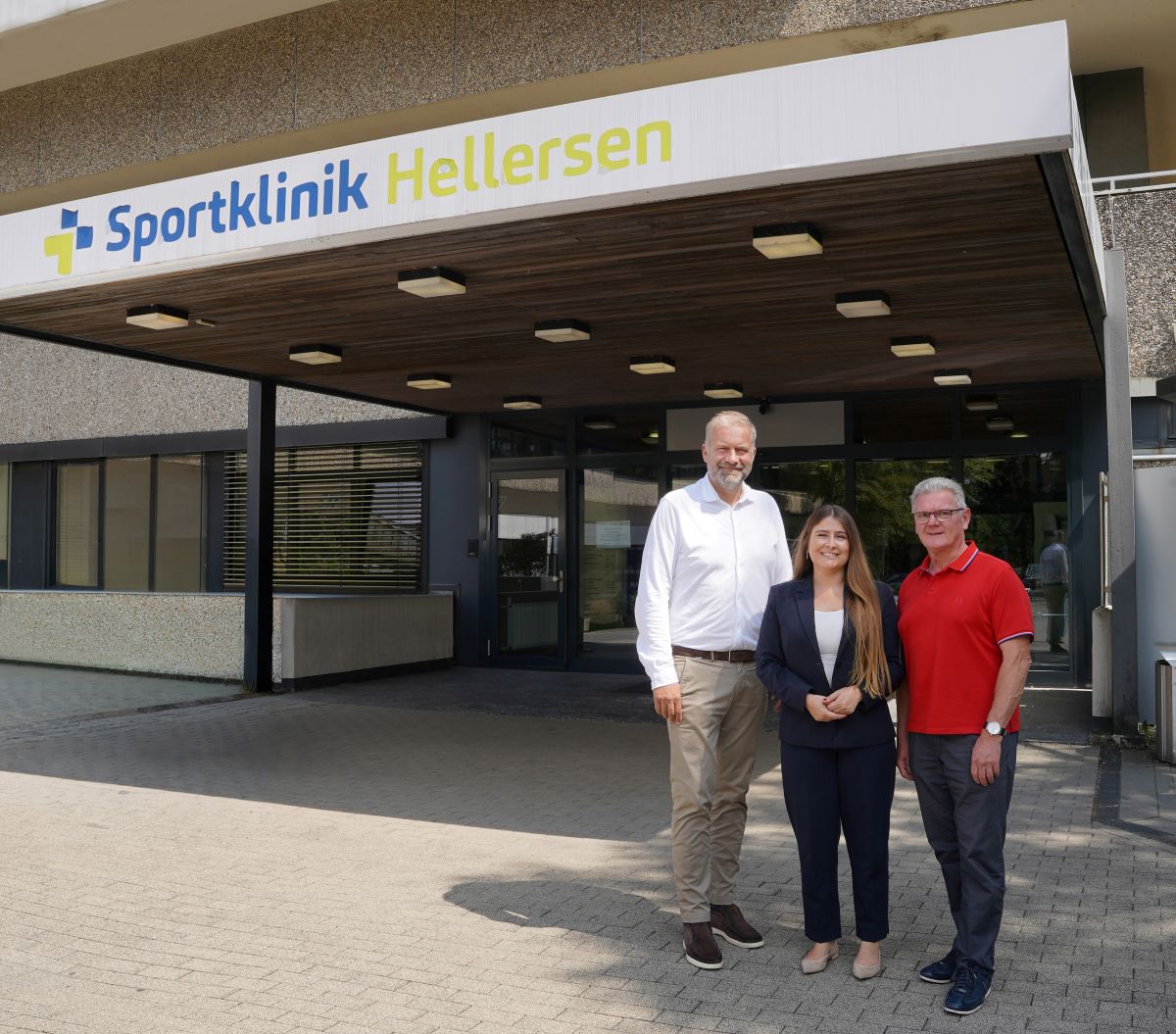
CDU Member of the Bundestag Tijen Ataoğlu (center) visited, as part of her summer tour of her congressional district and at the invitation of Stefan Klett (right), president of the North Rhine-Westphalia State Sports Federation and Sporthilfe NRW e. V., and Dirk Burghaus (left), Chairman of the Board of the Sportklinik Hellersen, the specialized clinic in Lüdenscheid. A shared goal of the discussion partners is to strengthen Germany’s position in international elite sports.
CDU Member of the Bundestag Tijen Ataoğlu visits Sportklinik Hellersen.
With an eye toward Germany’s bid to host the Olympic and Paralympic Games, federal policymakers, organized sports, and specialized sports medicine are working together: In early August, CDU Member of the Bundestag Tijen Ataoğlu met in Lüdenscheid with Dirk Burghaus, Chairman of the Executive Board of Sportklinik Hellersen, as well as Stefan Klett, President of the North Rhine-Westphalia State Sports Federation and Sporthilfe NRW e. V., the organization that operates the Sportklinik Hellersen. They share a common goal: to strengthen Germany’s position in international elite sports and advance the country’s Olympic prospects.
The discussion focused on the Sports Promotion Act passed by the Bundestag in mid-July 2026, Germany’s bid to host the 2036, 2040, or 2044 Olympic and Paralympic Games, and the importance of a high-performance sports medicine infrastructure. The visit took place during a special year for the Sportklinik Hellersen. In October 2026, the specialized clinic will celebrate its 80th anniversary.
A New Framework for Elite Sports Promotion
As early as 2016, the Federal Ministry of the Interior (BMI) and the German Olympic Sports Confederation (DOSB), together with the Conference of State Sports Ministers, had already adopted a reform plan to restructure elite sports in order to sustainably strengthen Germany’s position in international elite sports and improve the chances of athletic success at international competitions as well as at the Olympic and Paralympic Games. However, implementation has so far fallen short of expectations. The Sports Promotion Act is now intended to initiate further necessary reform measures and, for the first time, establish the federal government’s support for elite sports on a uniform and transparent legal basis.
“The goal is to sustainably improve the framework conditions for athletes and coaches and thereby create the overall conditions for greater international success,” says CDU Member of Parliament Tijen Ataoğlu, who voted in favor of the bill in the German Bundestag before the summer recess. At the heart of the law is the establishment of an independent elite sports agency as a foundation under public law. It is intended to consolidate key tasks related to funding and sports-specific management in order to significantly increase Germany’s chances of successful participation in international competitions. This also applies with regard to a bid for the Olympic and Paralympic Games. On September 26, the DOSB will decide which candidate will represent Germany in the international bidding process. Currently, Berlin, Munich, and the Cologne-Rhine-Ruhr region are in the running.
Olympic-Level Sports Medicine Infrastructure
The federal government’s initiative aligns with the efforts in North Rhine-Westphalia, a leading sports region: Under the presidency of Stefan Klett, the North Rhine-Westphalia State Sports Federation is committed to strengthening competitive and elite sports and advancing the Cologne-Rhine-Ruhr bid in the national selection process. North Rhine-Westphalia has numerous suitable sports and training facilities. “Sports success requires reliable structures and strong partners,” emphasizes Stefan Klett. “The Sportklinik Hellersen is a key component of the organized sports network and, with its expertise, contributes to a high-performing sports medicine infrastructure in North Rhine-Westphalia—an infrastructure that is indispensable for successful Olympic and Paralympic Games.”
The specialized orthopedic and sports medicine clinic was founded in 1946 by what is now Sporthilfe NRW e. V. to provide injured athletes with appropriate medical care. Since 1998, the sports medicine department at the Sportklinik Hellersen has also served as the official sports medicine examination center of the German Olympic Sports Confederation (DOSB). As recently as May 2026, its accreditation was reconfirmed and extended through 2034. This means the department remains one of the 29 DOSB examination centers nationwide dedicated to the medical care of elite and Olympic athletes.
“Sports have been part of our DNA for 80 years,” explains Dirk Burghaus, who has served as Chairman of the Board since 2017. Especially when it comes to caring for national team and elite athletes, modern performance diagnostics, highly specialized treatments, and the fastest and safest possible return to training and competition are closely intertwined. “We know from experience that internationally successful elite sports require not only reliable support but also highly specialized medical care. This is precisely where we have been making our contribution for decades.”
Specialization, Innovation, and International Exchange
During her visit, Tijen Ataoğlu also learned about the medical and strategic projects for the future at the Sportklinik Hellersen.These include, among others, the Hellersen Endoprosthetics Robotics Center, the German Spine and Scoliosis Center, the establishment of a new AI task force for digital transformation, and the development of an international medical cooperation network in the Middle East region. Since 2023, the sports clinic has been driving global knowledge transfer under the umbrella brand Hellersen Hospital. In early 2026, the specialty clinic was certified by the Arab Board of Health Specializations. As the first training center outside the Arab states, it has since been authorized to offer specialist training in orthopedics and trauma surgery in accordance with the Arab Board’s standards.
Tijen Ataoğlu also brings a close connection to the region and international experience through her personal and professional background. A native of the neighboring Hanseatic city of Wipperfürth in the Oberbergischer Kreis, she completed her law degree at the universities of Cologne and Istanbul. She has served as a judge in the Hagen Regional Court district since 2019 and was appointed a tenured judge at the Hagen Regional Court in 2023. Before joining the German Bundestag, she most recently served as chief of staff to the CDU parliamentary group leader in the North Rhine-Westphalia state parliament and as coordinator for parliamentary investigative committees. In the Bundestag, she serves as vice-chair of the Committee on Election Verification, Immunity, and Rules of Procedure. In addition to sports policy and strategic issues for the future, the discussion also covered the impact of current health policy decisions on specialized clinics and the necessary framework conditions for a future-proof healthcare system.
Press Contact
Sarah Burghaus
Head of Marketing, PR & Customer Service, Press Spokesperson
sarah.burghaus@hellersen.de
Marketing & PR
marketing@hellersen.de

