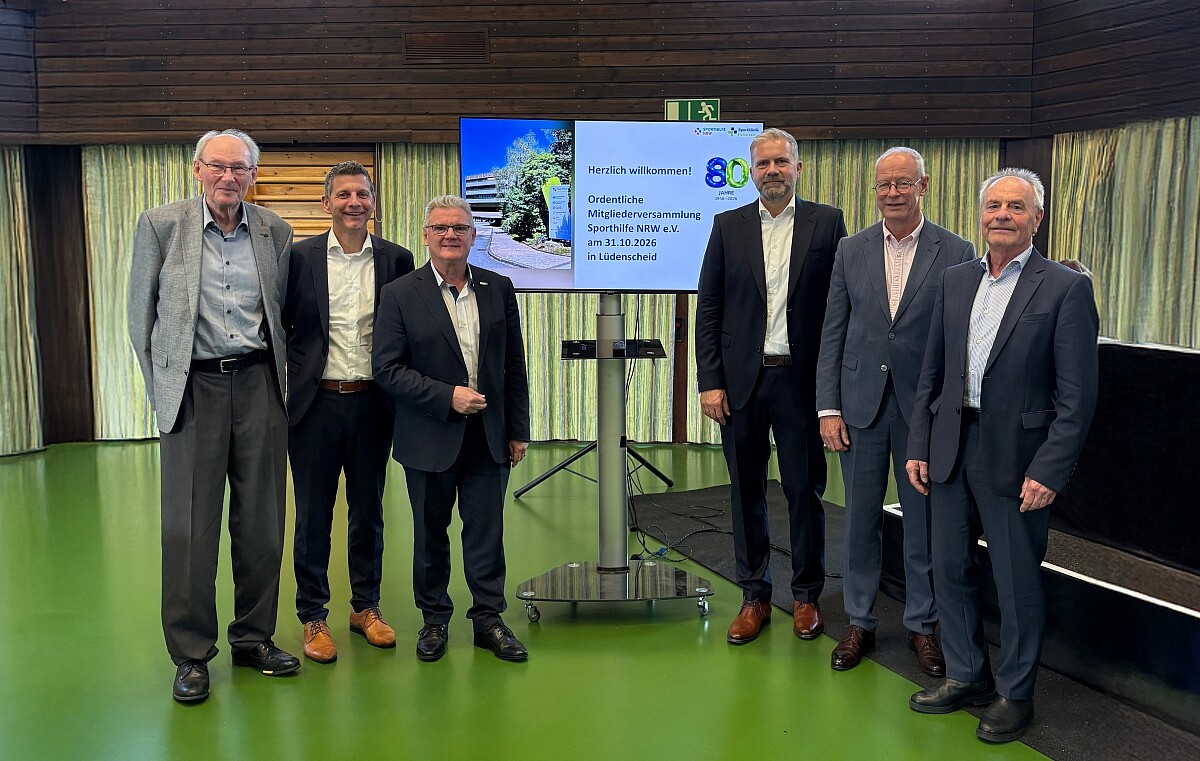
On October 31, 2026, the Presidium and the Executive Board of the sponsoring association Sporthilfe NRW e.V. hosted a general meeting at the clinic’s Lüdenscheid location (from left to right): Reinhard Ulbrich (Presidium), Stephan Franz (Executive Board, Sportklinik Hellersen), Stefan Klett (President), Dirk Burghaus (Chairman of the Executive Board, Sportklinik Hellersen), Dr. Michael Timm (Vice President), Diethelm Krause (Presidium)
Annual General Meeting in the Anniversary Year: Net Income Exceeds Projections and Clear Expectations for the State of North Rhine-Westphalia
Eighty years after its founding, Sportklinik Hellersen has developed into one of the largest and leading specialized orthopedic clinics in Germany. From its roots in organized sports, it has evolved into a highly specialized clinic for diseases, injuries, and pain of the musculoskeletal system, which today plays a vital role in healthcare in North Rhine-Westphalia and far beyond. The positive economic trend of recent years is also continuing. This became clear at this year’s general meeting of the sponsoring association, Sporthilfe NRW e. V., held at the clinic’s Lüdenscheid location. In addition to the positive financial results and future plans, the focus was on the clinic’s medical advancements and investment prospects, as well as the pending decision regarding state funding from North Rhine-Westphalia.
Good healthcare requires a solid financial foundation. That is why the reported results are particularly encouraging given the strained financial situation facing many hospitals in Germany: The sponsoring association Sporthilfe NRW e. V. once again closed the 2025 fiscal year with a net income, even exceeding its budget. This positive financial result is the outcome of consistent medical and organizational development. With the allocation of service groups as part of the recently completed hospital planning process, the state of North Rhine-Westphalia has explicitly reaffirmed the importance of the Sportklinik Hellersen for healthcare in the region.
General Meeting Focused on Solidarity and Future Prospects Following
opening remarks by Stefan Klett, President of Sporthilfe NRW and the North Rhine-Westphalia State Sports Federation, the agenda featured reports on the past fiscal year, the 2025 annual financial statements, and the outlook for economic development. Dirk Burghaus, Chairman of the Board of Directors of Sportklinik Hellersen, briefed the members on the clinic’s current situation and future plans. In particular, he addressed ongoing medical advancements and the planned investments in the facility. The members recognized the successful work by unanimously granting discharge to the Executive Board and the Presidium and also unanimously approved all new resolutions put to a vote.
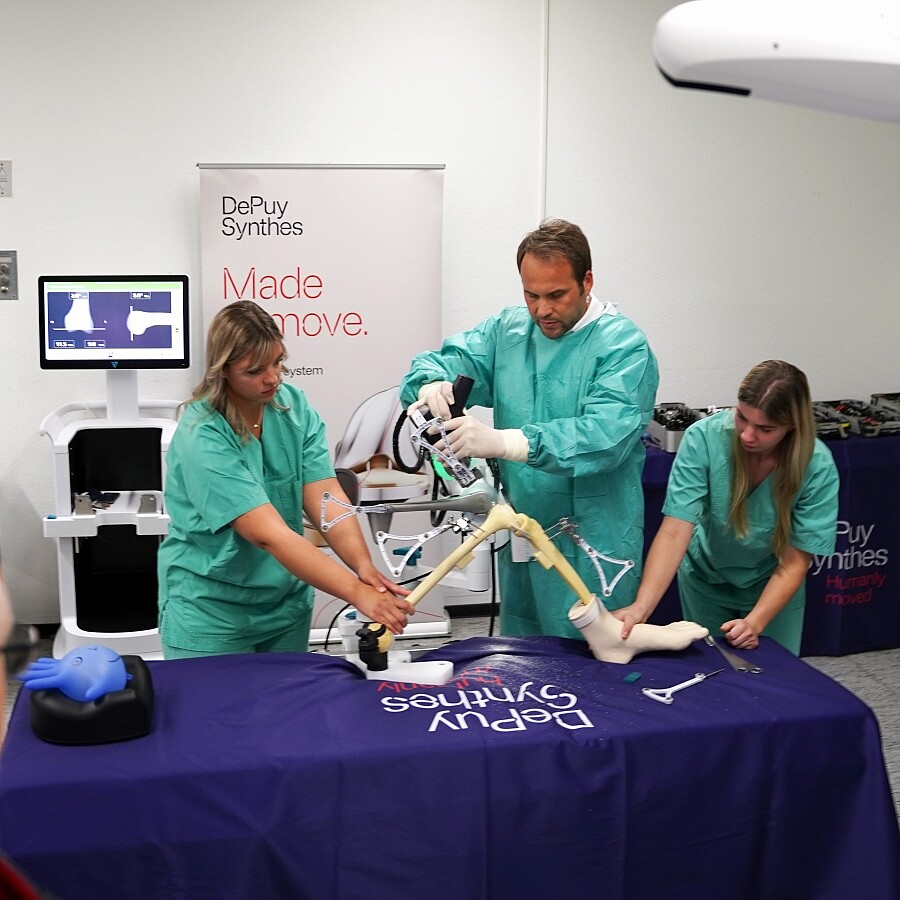
Dr. Stefan Schmidl (Chief Physician of Endoprosthetics) demonstrated in a live presentation how the surgical robot assists the surgeon with precise planning and incision placement.
Advancing Medical Specialization and Modernization The
The Sportklinik Hellersen continues its medical development. A key focus is the expansion of specialized surgical care. In October 2026, a second surgical robot was installed, enabling the clinic to further expand its expertise in endoprosthetics. Digitalization has also been systematically advanced since June through a dedicated department for AI, automation, and digital transformation. The goal is to use modern technologies to streamline processes, reduce the workload on staff, and support patient care. The first tangible results from completed projects are already having a positive impact.
Furthermore, extensive construction and structural investments are planned to support the long-term development and implementation of the NRW Hospital Planning initiative. The project includes a new operating room building, modern intensive care and monitoring units, the further development of emergency care, as well as measures for energy efficiency and climate adaptation. These measures require a reliable outlook for investment and funding.
Another topic was the question of how the clinic can remain financially stable even under future health policy conditions. Further discussions with the member organizations also addressed the status of ongoing funding procedures and the pending decision by the state of North Rhine-Westphalia. In this context, the sports organizations articulated clear expectations of the state: The necessary investments and the long-term development of the Sportklinik Hellersen require sound decisions and a reliable planning framework.
To continue on the current course despite growing challenges, a business plan for 2027 was presented that takes into account the effects of healthcare reforms, rising costs, and the economic and political framework conditions. In light of rising costs and increasing statutory cost-cutting measures, Sporthilfe NRW also emphasizes the responsibility of policymakers to create reliable framework conditions for hospitals. Reforms must ensure the long-term quality of patient care while also enabling and supporting necessary investments in staff and modern infrastructure. Stefan Klett underscored the importance of reliable investment funding: “Funding is no substitute for sound financial management. However, sound financial management must not be a reason to view necessary investment funding as dispensable.”
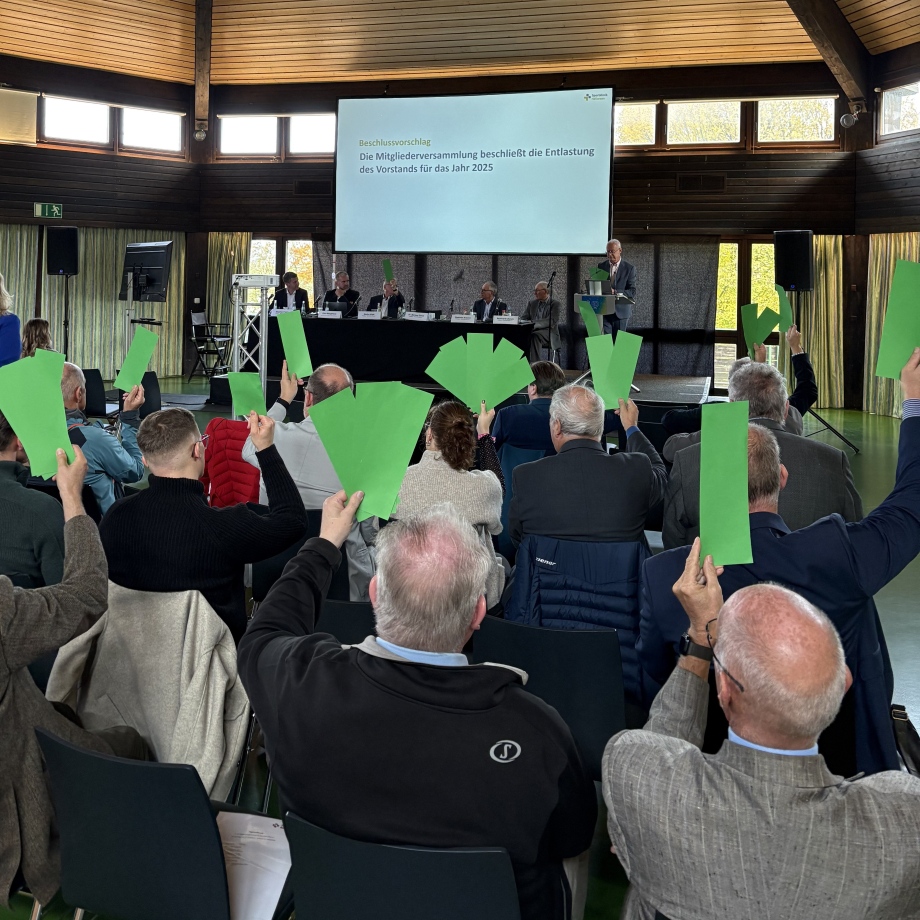
The member organizations of Sporthilfe NRW stand united behind the Sportklinik Hellersen and expect the state of North Rhine-Westphalia to provide planning certainty for the upcoming investments.
A clear expectation for the state of North Rhine-Westphalia: planning certainty for the future
. Especially in the current health policy environment, the positive development of this specialized clinic is of particular importance. While numerous hospitals in Germany are facing rising costs and economic uncertainties, the Sportklinik Hellersen has consistently expanded its medical services over the past ten years and sustainably strengthened its financial foundation. This stability forms an important basis for further development. Financing the planned extensive construction and structural measures remains a separate responsibility.
“I welcome the fact that the member organizations are advocating for a clear investment outlook,” says Dirk Burghaus, who has served as Chairman of the Board of Directors at Sportklinik Hellersen since 2017. “We have advanced our medical specialization and sustainably strengthened the clinic’s financial foundation. Now we also need a clear commitment from the state so that we can jointly plan and implement the next investment steps.”
Sporthilfe NRW therefore expects firm decisions regarding the ongoing funding procedures and a reliable timeline for the next investment steps. In this regard, it is counting on constructive cooperation with the state of North Rhine-Westphalia.
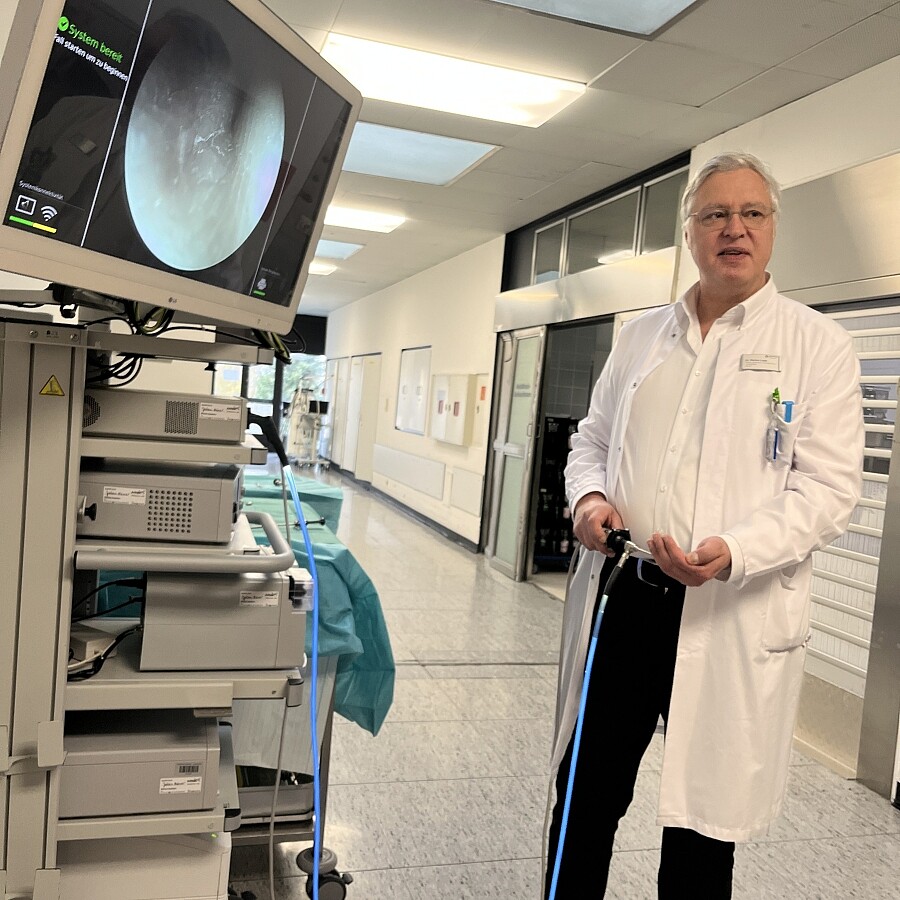
Dr. Markus Leyh (Chief Physician of Shoulder, Elbow, and Knee Surgery and Traumatology) provided insights into the outpatient surgery unit as well as arthroscopic procedures.
From the History Wall to Modern Surgical Technology This
year’s general meeting of Sporthilfe NRW e.V. also marked the 80th anniversary of the Sportklinik Hellersen. During a subsequent tour, the members traced the clinic’s history. As early as 1970, Hellersen set new standards as Europe’s most modern and largest hospital for sports injuries. Since 1998, the sports medicine department has also been an accredited examination center for the German Olympic Sports Confederation (DOSB) and the North Rhine-Westphalia State Sports Federation. That same year also marked the beginning of a collaboration with the German Football Association (DFB) for the sports medicine examinations of Bundesliga referees. Members were able to see how the clinic has evolved since then at various stations—from the new History Wall to modern surgical care and robotics, all the way to sports medicine performance diagnostics.
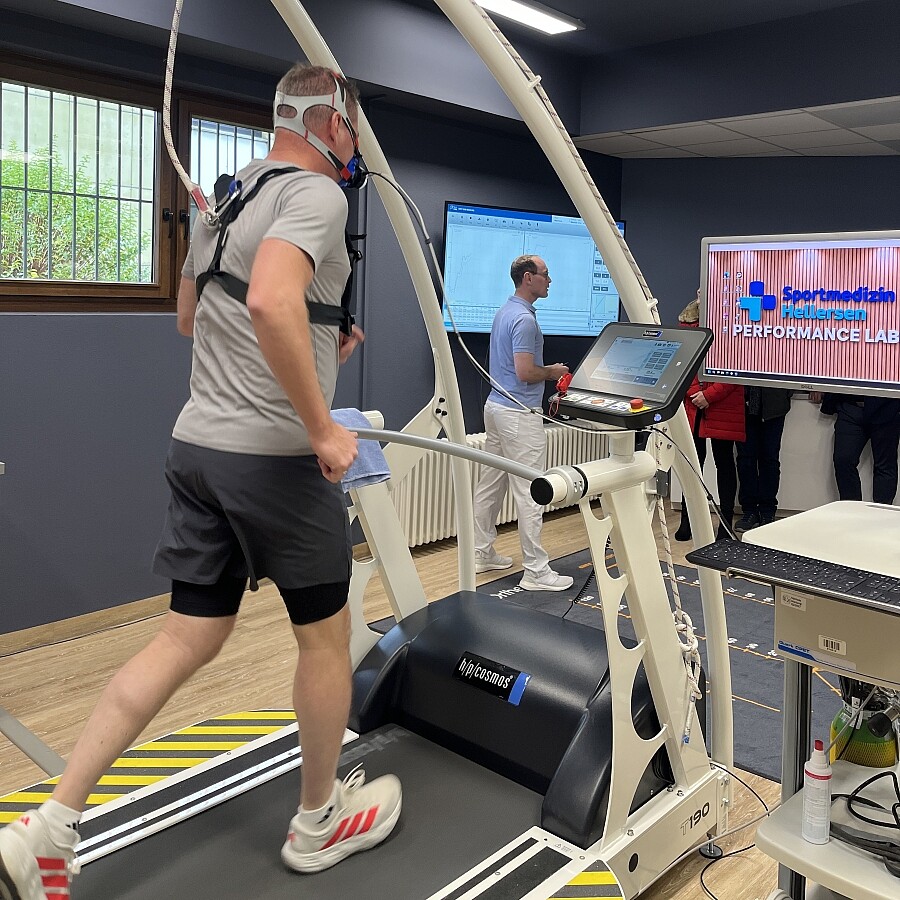
In the Department of Sports Medicine, not only elite athletes but also recreational athletes can have their fitness tested as part of a performance assessment.
Well-Prepared
for Crisis Situations as
Well The history of the Sportklinik Hellersen began in 1946 with the provision of medical care for injured athletes, a cause championed by Sporthilfe NRW, which was still in its formative stages at the time. Eight decades later, in light of the current security situation, another aspect is gaining importance: the crisis and defense capabilities of hospitals. The planned investments in the medical infrastructure of the Hellersen Sports Clinic can therefore also make an important contribution to medical crisis preparedness.
The Sportklinik Hellersen already meets key medical requirements in this regard: According to an analysis of the 2024 quality reports, it ranks first among Germany’s five largest orthopedic clinics with 83 percent of its physicians being board-certified specialists. It also has a high proportion of board-certified specialists in anesthesiology and critical care medicine. The planned modernization of the intensive care and monitoring units is intended to strengthen routine patient care while also creating better conditions for special crisis situations. As a result, the Sportklinik’s continued development is increasingly becoming a focus of public interest even beyond the realm of organized sports.
Image credit (all photos on this website): © Sportklinik Hellersen
Press Contact
Sarah Burghaus
Head of Marketing, PR & Customer Service, Press Spokesperson
sarah.burghaus@hellersen.de
Marketing & PR
marketing@hellersen.de

